
Menu Food R&D & Professional Kitchen Design
Menu to Kitchen: from dish idea to a kitchen that works
A hands-on course that takes you from concept to a complete menu, and actually into operation. Over 6 sessions (18 hours), you will cook, test and refine dishes, with 10+ templates to take home. The full course fee includes ingredients, R&D and hands-on practice at the studio.
Struggling with these problems?
7 situations F&B operators often face when doing menu R&D and kitchen design.
Designing the kitchen first, thinking about the menu later
Only after construction do you find the kitchen flow is wrong and the zones are laid out badly. Renovation costs an extra 50-150 million VND to fix.
Dish R&D without a system
Every new dish starts over from scratch. With no R&D Log and no standardized process, you cannot develop new dishes professionally.
Food cost out of control
Revenue looks fine but profit falls short. You do not know the exact food cost % of each dish or which dishes are losing money.
Operations depend on individuals
When key staff leave, the whole kitchen stops to retrain. There is no system documentation that can be handed over to newcomers.
Wrong kitchen flow: peak hours spiral out of control
Staff block each other, food comes out slowly and guests complain, but you cannot trace the cause to the kitchen design.
Signing off drawings without enough knowledge
You paid the design firm but cannot read the drawings or know which questions to ask, and only see the mistakes after construction.
Want to open more sites but cannot standardize
Quality is uneven across sites and there is no Standardized Recipe Card: expanding just multiplies the problems.
A hands-on course: move from gut-feeling R&D and intuitive kitchen design → build a menu R&D system and a kitchen that works
THE MENU DECIDES THE KITCHEN: the principle running through all 6 sessions. 5 differentiators of the program.
Instructors are running real F&B consulting alongside teaching. Guests are people who design kitchens and run professional kitchens every day.
70% of the time is spent practicing on your own brand. A real R&D studio, real partner kitchens, real outputs, not simulated cases.
AAU Academy's toolkit has been applied in consulting for F&B chains in Vietnam: dish standardization tools (Recipe Card, BOM), pricing tools, and a brand positioning canvas (DNA Profile Canvas).
6 sessions in 2 chapters: Menu Food R&D (Sessions 1-3 at the Studio) and Kitchen Design (Sessions 4-6, including a Market Visit to a real kitchen). THE MENU DECIDES THE KITCHEN: the guiding principle.
Tuition includes dish testing costs, R&D practice ingredients at the studio, and field visit costs. Learners do not need to prepare any extra costs: fully transparent.
Who is this course for?
Core audience groups, and who the course is not right for at this time.
Owners who are operating or preparing to expand
Own or are preparing to open a cafe, restaurant, bubble tea chain, Cloud Kitchen... Want to build a solid R&D and kitchen operations system from the start, or are restructuring existing sites to standardize before expanding. This group needs to make overall decisions: from Menu Concept to kitchen design to operations control.
Operations managers responsible for R&D standardization
Managing restaurant or F&B chain operations, or assigned to roll out system standardization. Need a framework deep enough to build Standardized Recipes, ingredient norms and a standard R&D process, plus enough kitchen design knowledge to contribute meaningfully to decisions on floor plan, flow and stations, without depending entirely on the contractor.
Head Chefs / R&D Chefs wanting to move up to a system level
Head chefs responsible for dish development or menu standardization for a chain. Need the language and tools to work with the design team, control costs and scale recipes across multiple sites.
Only have an F&B idea, not yet running any store
The course targets people who already have operating experience and a real context to practice in. If you are at the starting stage, you may want to take the Winning Concept F&B course first.
Want to learn cooking for an F&B business
The program focuses on recipe standardization, cost optimization, kitchen operations and scalability. It therefore does not go into cooking technique details.
Looking for a purely construction-engineering kitchen design course
The course focuses on systems thinking for business decision-makers. The technical part is enough to work with a designer and does not replace an architect or M&E engineer.
Not committed to attending all 6 sessions
Session 3 (R&D Studio practice) and Session 6 (Market Visit to a real kitchen + construction management) in particular are the 2 core sessions that produce outputs. Skipping them seriously affects the quality of the deliverables you take home.
6-Session Learning Path: 2 Chapters
Menu Food R&D (Sessions 1-3 at the Studio) → Kitchen Design (Sessions 4-6, including a Market Visit to a real kitchen). From dish idea → kitchen design → budgeting & construction management.
Chapter 1 — R&D Menu Food
Sessions 1, 2 & 3 · Theory & Hands-on at the Studio
Session 1
R&D Overview & R&D Planning5-stage R&D lifecycle · R&D brief · Market & competitor research
- 5 stages of the R&D lifecycle: WHY (business problem) → Planning → Execution & Testing → Evaluation → Chain-wide Rollout
- WHY: inspiration-driven R&D vs goal-driven R&D; R&D tasks for an operating store & menu goals for a new store (positioned · profitable · operable · replicable)
- Planning: how to write an "R&D brief" + 4 work blocks (Research · Dish Development · Resources · Test Plan) + 6 dimensions of customer research
- Competitor research: teardown of 3-5 stores + Field R&D Scan scored on 7 criteria + decoding flavor & aroma to recreate and differentiate
- Testing & evaluation: 4 test levels by scale + 6 metrics for new dishes + feedback classification → Pass / Adjust / Stop decision
- Output: a Dish File for your own model
Session 2
Dish R&D Process & Techniques6 stages: Ingredients → Prep → Storage → Processing → Cooking & flavor balancing → Plating
- 6-stage R&D flow: each stage is an "adjustment knob" to make a dish different + a food safety (HACCP) axis throughout
- Ingredients: origin/breed determines ~50% of quality: a map of Vietnamese chicken, duck, pork, beef, fish, shrimp, crab, swimming crab and snail breeds & R&D applications
- Prep & heat: European vs Asian style; core temperature & doneness for each meat; FIFO storage & aging techniques (dry-age, water-age, butter-age, salt-aging)
- Processing: equipment × cooking methods; Maillard reaction & caramelization; aromatic vegetable bases for stock (mirepoix · Vietnamese · Thai)
- Cooking & flavor balancing: balancing 5 tastes & how to "fix" a dish; 3-step "change exactly 1 variable" process + R&D Log; Local ↔ Fusion upgrade scale
- Cost control & presentation: Yield AP↔EP + mix-and-match (1 ingredient for many dishes); 5 plating principles
Session 3
R&D Practice & Sensory EvaluationStudio · Sensory Scorecard 1-9 · Radar comparison chart
- Exercise A: chicken breast through 4 cooking methods (pan-seared · sous-vide · boiled · grilled): read the differences in flavor, aroma and texture & position the dish
- Exercise B: potato through 4 treatments (duck fat confit · sous-vide · boiled · roasted) → a mash base tied to cost
- Sensory evaluation with a Sensory Scorecard (1-9 hedonic scale): flavor · aroma · texture · appearance · overall, cross-scored to reduce bias
- Visualize with a radar chart: see the trade-offs between methods at once and choose by your brand's priority axes
- Output: a complete dish file + a structured sensory evaluation
Chapter 2 — Kitchen Design
Sessions 4, 5 & 6 · Design → Engineering → Construction · includes a Market Visit to a real kitchen
Session 4
Kitchen Design for Each F&B ModelKitchen DNA · 5-step process · 7 kitchen models · Central kitchen
- Foundation thinking: 3-axis concept matrix + 5-element Kitchen DNA: read the business model before drawing the kitchen
- 5-step process for every model: Concept → Menu → Station → Equipment → Workflow (the menu decides the kitchen)
- Kitchen configuration for 7 models: Cafe & Bubble Tea · Asian Restaurant · European Restaurant · Hotpot & BBQ · Beer Garden · Bakery · Ice cream (gelato)
- Read real project drawings (Indochine Restaurant case · a Cafe · a Bakery kitchen) woven into each model
- Optimize when mixing multiple lines: which stations are shared/separate · make in-house or outsource · when a Central Kitchen is needed
- Output: Kitchen DNA Canvas + a preliminary BOH Blueprint for your own model
Session 5
Layout & Technical Drawings (MEP)8-step one-way flow · M&E (electricity/water/gas/exhaust) · Support areas & storage
- 8-step one-way kitchen layout: Receiving → Prep → Storage → Processing → Pass → Service → Clearing → Washing+Waste (separating clean/dirty flows)
- 3 separate prep stations (meat / seafood / vegetables) + color-coded knives and boards to HACCP standards
- M&E engineering: Electrical (kVA load, generator + ATS) · Water (RO, hot 60-82°C, grease trap) · Gas (emergency valve, leak sensor)
- Exhaust + make-up air (the #1 mistake of non-specialist contractors) & wet area construction (epoxy, FRP, coving)
- Support areas & storage (waste room, airlock, dock, storage sizing); review MEP drawings of a real project
- Output: One-way Layout + Utility Requirement Sheet
Session 6
Brief, Budgeting & Kitchen Construction ManagementMarket Visit to a real kitchen · Briefing 2 design teams · CapEx budgeting · Acceptance
- Market Visit at a real kitchen: learn directly in a kitchen/site in operation, reading drawings & inspecting the actual condition on the spot
- Briefing to coordinate 2 design teams (Architect ↔ Kitchen-Bar) + a 14-item Brief Checklist to avoid cost overruns from an incomplete brief
- CapEx budget = Equipment + Construction + MEP + Consulting/Permits + 10-15% contingency
- Choosing & managing contractors: 3 management models (separate teams / general contractor / hired supervision) + contract terms
- Construction management & acceptance: 6-phase Gantt, change order management, 72h cold-chain trial run, handover documents
- Output: Kitchen file + contractor brief + investment plan
5 key deliverables you take home after the course
6 outputs closely tied to the curriculum: each session you take home a toolkit to apply right away, with no need to build from scratch.
Dish File (Session 1)
A complete R&D file for a dish/dish line: R&D brief (problem + numeric goals) · metrics table (flavor/color/portion/max food cost) · results of 4 test levels & evaluation on 6 metrics · Pass/Adjust/Stop decision + lessons. Reuse it as your store's internal training material.
Standardized Recipe Set + R&D Log (Sessions 2-3)
4-layer Recipe Card (Foundation / Processing / Finishing / Presentation) + BOM Master Sheet with automatic cost% + R&D Log + Sensory Scorecard (1-9 scale) & radar chart for sensory evaluation.
Kitchen DNA Canvas + BOH Blueprint (Session 4)
5-element Kitchen DNA sheet + 5-step BOH Blueprint (Concept → Menu → Station → Equipment → Workflow): build the right kitchen configuration for your own business model.
One-way Layout + Utility Requirement Sheet (Session 5)
8-step one-way kitchen flow diagram + Equipment Schedule + Utility Sheet (electricity / water / gas / exhaust + make-up air) + HACCP color-coded knife and board checklist: enough to brief an MEP contractor.
Kitchen Investment & Construction File (Session 6)
14-item Brief Checklist + CapEx budget (Equipment + Construction + MEP + Consulting/Permits + 10-15% contingency) + Acceptance & Commissioning checklist + handover documents: make investment decisions and manage contractors.
Hands-on Learning Experience
5 elements that make a course memorable and effective.
Small classes of 10-15 learners
Ensures every learner gets personal attention. Instructors have time to hear each person's real case and give direct feedback.
Hands-on Exercises at the R&D Studio
No simulated cases. Every exercise applies directly to the learner's real concept: real dishes, real photos, real costing.
Market Visit at a Real Kitchen
Visit a kitchen in real operation and learn on the spot: observe the flow, read drawings & actual conditions, and Q&A with the head chef and manager.
Coaching Throughout the Sessions
In each session, coaching is done on the learner's own F&B model, not just listening to theory and fending for yourself.
AAU Alumni Community
Connect with restaurant owners & F&B experts who have studied at AAU: Q&A, sharing operating experience and opportunities to collaborate and grow.
Course Instructors
Founders & F&B chain consulting experts with 10 to 15+ years of hands-on experience.
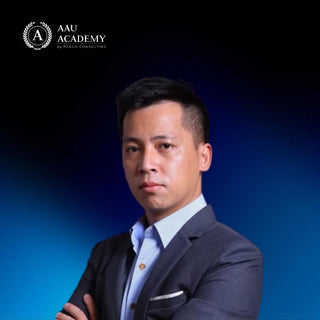
Mr. Tien Tien
Founder AAU Academy & PEACH Consulting
15 years of experience in in-depth F&B consulting and training. Has directly advised on strategy, operations standardization and restructuring for dozens of F&B businesses: cafe chains, casual restaurants, bubble tea, central kitchens... Builder of the consulting-based training method in professional F&B training.

Mrs. Chau Tieu Ngoc
Kitchen Design: Operations Director, Sunshine Kitchen Equipment
15 years of in-depth F&B consulting and training experience in kitchen design. Has directly advised on infrastructure, layout and MEP systems for dozens of F&B kitchen projects, from chain central kitchens to independent restaurants.
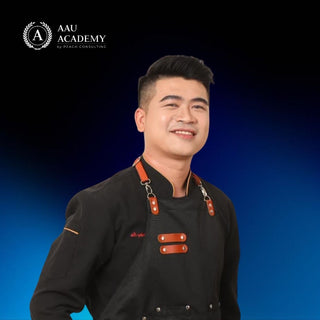
Mr. Sin
Menu R&D: Head Chef, Asian-European Restaurant
A professional head chef with many years of experience running Asian-European fine-casual kitchens. Deep expertise in recipe R&D, recipe standardization (Recipe Card) and concept-based menu development.
What do learners say?
Real feedback from people who have "been through" AAU Academy.
I find the course very suitable for people who want to start a business like me. It is a solid foundation to run your own project professionally and methodically and build your own F&B business.
What impressed me first was the mentors and the AAU curriculum. Every lesson solves important problems that not everyone knows about.
A very well-structured training center with practical, easy-to-understand content. Instructors are enthusiastic and always support and answer questions promptly.
AAU Offers and Commitments
1-on-1 Coaching Throughout the Course
In each session, coaching is done on the learner's own F&B model. We never leave you to "learn and then fend for yourself".
Retake the course for free
You can retake topics you are not yet solid on in the next intake of the Menu Food R&D & Kitchen course at no extra cost.
AAU commits to training quality and knowledge you can apply throughout the course. Systemizing Food R&D and Kitchen Design knowledge helps business owners keep operations consistent.
Frequently asked questions
Answers to common questions before you register.
I do not have a specific concept yet. Can I join?
You can, but the effectiveness is lower. All exercises require a real concept to apply. We recommend joining once you have a preliminary idea of your F&B format. Or you can take the Winning Concept F&B course first to develop a concept for your brand.
Does the 10 million VND tuition include ingredient costs?
Yes, 100%. Ingredient and Recipe Testing costs for Session 3 are already included in the tuition. Learners do not need to prepare any extra costs throughout the program.
Can I learn online?
The course is currently offline only. Session 3 (Studio practice) and Session 6 (Market Visit to a real kitchen) are strongly recommended to attend in person. The theory sessions are being developed in a hybrid format. Contact AAU Academy directly to discuss learning options.
The course teaches kitchen design. Do I need technical knowledge?
No. The goal of the course is not to turn you into a specialist designer, but to give you enough knowledge to work with a design firm (Designer), avoid being misled, and make informed decisions.
I am a head chef. Is the kitchen design part suitable for me?
Very suitable. Head chefs are often consulted but lack a clear working framework. The course gives you the language and tools to genuinely influence design decisions.
What if I am too busy to attend all 6 sessions?
You can make up the theory sessions (1, 2, 4, 5) in the next course. For Session 3 (Studio practice) and Session 6 (Market Visit to a real kitchen), AAU encourages you to attend with your group to ensure the quality of the output.

Let AAU Academy walk with you
The Menu to Kitchen journey: from a dish idea to a kitchen that runs. Leave your details and the AAU team will contact you for a free consultation within 24 hours.
Or call now 056 566 7686 (Mon–Sat, 9h–18h)