
Bean to Business: Investing in and Operating a Specialty Coffee Model
From green beans to a business model
8 sessions for investors and model owners who want to build or upgrade a specialty coffee chain. Four business sessions at AAU Academy: model selection and positioning, single-outlet financial model, menu, bar and space, operations and chain replication. Four technical sessions at the Mountain Pearl roastery: green beans, roasting, extraction, tasting and blending. You leave with a complete business model dossier reviewed by two experts.
Where do you stand with a specialty coffee model?
6 common situations investors and model owners face before committing capital.
Investing on inspiration, with no financial model
You love coffee and want to open a specialty cafe, but have no worksheet for capital investment, breakeven point and payback period to know whether the model can survive.
Can't tell specialty from mass-market
You haven't grasped the quality criteria, cost structure and customer expectations of the specialty segment, so you price wrong, choose the wrong ingredients and communicate wrong.
Designing the space before finalizing the menu
You sign the design contract and only then think about the menu, leading to a bar with too little room, equipment that can't handle peak-hour capacity and a roasting area that fails technical requirements.
A model that depends on one great barista
Quality rises and falls with whoever is behind the bar. When the star leaves, the cafe loses its standard and can't be replicated at a second outlet.
Not knowing whether to roast in-house or buy out
You haven't calculated the economics of a roastery, the weight loss in roasting and the impact on cost of goods, so you decide by gut feeling or by what the equipment seller says.
Inconsistent quality across outlets
The same recipe but a different taste at every bar, because the four extraction variables aren't standardized and there are no recipe cards to repeat.
A joint program: half business, half technical
4 sessions at AAU Academy build the model and financial framework; 4 sessions at the Mountain Pearl roastery cover the value chain from green beans to the cup.
Block 1 builds the model, finance, menu and operations framework. Block 2 equips you with the technical value chain at a level sufficient to lead and control quality, not to turn investors into roasters.
The final four sessions take place at the Mountain Pearl roastery: inspecting green bean defects, observing and joining roast batches, pulling espresso to a standard recipe, and tasting and blending by process.
The design of the bar, roasting area and space is done only after the menu and concept are finalized, a principle that avoids the biggest waste in setup.
Each session produces one component: a concept description, financial model, space layout, operations framework, sourcing strategy, roasting direction, extraction recipe set and blend recipe.
Learners present the complete dossier and receive feedback from two angles: product and quality, and investment and operations.
Who is this program for?
3 groups of investors and model owners, and those who are not a fit right now.
Investors preparing to open a specialty coffee model
Considering committing capital and needing a framework to choose a model that fits your resources, build the financial model and assess risks before committing to a site.
Cafe owners who want to move up to the specialty segment
Already running a cafe and want to shift positioning: standardize input quality, redesign the menu and price by perceived value.
Chain owners preparing to replicate or set up a roastery
Need a standard process set to open a second and third outlet while keeping quality consistent, and a basis for deciding when to set up a central roastery.
Looking for a barista class to earn a certificate
This is an investment and model operations program. The technical part is at a level sufficient for owners to lead their teams and control quality, not a barista vocational course.
Want ready-made brewing recipes to apply immediately
The course teaches principles and how to standardize your own recipes for the equipment and ingredients you use, and does not hand out shared recipes.
Haven't defined your budget and investment goals
Most of the value lies in running the financial model on your real numbers; without a budget direction, hypothetical scenarios lack a basis.
Need to learn fully online
The four technical sessions require attendance at the roastery to practice on real equipment and samples, and cannot be replaced by online delivery.
8-session roadmap: two blocks, two locations
Throughout the course, each learner builds up their own business model dossier and presents it at the closing session.
Block 1: Business Knowledge
Sessions 1 → 4 · AAU Academy, 343 Pham Ngu Lao
Session 1
Industry overview and business model selectionSpecialty industry · 6 models · Positioning · Concept · 3 hours
- The specialty coffee concept and the criteria that set it apart from mass-market; quality score thresholds and international reference frameworks
- The value chain from farm to cup: the links and where value is really created; size, growth rate and headroom of the Vietnamese market
- Six common models (roaster-cafe, in-depth manual brew bar, specialty chain, hybrid model, takeaway kiosk, mobile model), compared by capital, margin, operational complexity and replicability
- Four lenses for market analysis and building the target customer profile by segment, behavior and spending power
- Practice: sketch the concept, positioning and business model for your own project: the Concept description
Session 2
Model investment and the financial caseCapital structure · Specific costs · Outlet P&L · Pricing · 3 hours
- Initial capital items by model: premises, fit-out and construction, bar equipment, roasting area, furniture; fixed versus working capital, and contingency principles
- Three critical cost groups of the specialty model: high ingredient cost of goods, skilled labor, equipment depreciation; hidden costs that are often overlooked
- Single-outlet P&L: revenue, cost of goods, operating costs, break-even point, cash flow and payback period
- Pricing by target cost-of-goods ratio, by perceived value and by competitor reference; controlling cost of goods from the product design stage
- Practice: build a single-outlet financial model on a template and run what-if scenarios on rent and customer traffic
Session 3
Menu, Bar and SpaceSpecialty menu · Equipment · Roasting area · Space concept · 3 hours
- Principles of menu structure, the optimal number of items and a product ladder from signature to mass-market; performance analysis using a margin and popularity matrix
- Deriving equipment needs from the menu: espresso machine, grinder, manual brewing tools; calculating capacity from peak-hour traffic and building an equipment budget
- Bar ergonomics and one-way flow: ingredient flow, staff flow, service flow; identifying peak-hour bottlenecks
- Requirements for placing a roasting area at the outlet: power load, smoke extraction and odor removal, fire safety
- Practice: a concept and space layout including a detailed menu, bar plan, roasting area location and guest area arrangement, used as a working document with the design team
Session 4
Model Operations and Chain ReplicationCore SOPs · Staffing · Quality control · Roastery · 3 hours
- The difference between an outlet that can operate and a chain that can be replicated; the core set of standard operating procedures
- Management systems: point-of-sale software, inventory management, order management
- Recruiting, training and retaining skilled baristas; reducing dependence on outstanding individuals through career paths
- Maintaining consistent quality across multiple outlets: control tools and frequency
- Scale conditions for setting up a central roastery, economies of scale, centralized quality control and shelf-life management
Block 2: Technical Knowledge
Sessions 5 to 8 · Mountain Pearl Roastery, Thu Duc City
Session 5
Green Beans: Supply Chain and Input QualityVarieties & processing · Quality · Pricing · Evaluation practice · 3 hours
- Business connection: green beans are at once a brand story, a supply risk and the place where margin is formed
- Coffee varieties, growing regions and natural, washed and honey processing methods, and their impact on flavor and cost
- Quality grading systems, defect classification, moisture, screen size; traceability, seasonality and supply risk
- Green bean price structure and principles for negotiating with farms and importers
- Practice: sorting and inspecting bean defects, comparing samples by growing region and processing method, reading quality sheets and calculating the landed cost of a lot
Session 6
Roasting: Standardization and Flavor IdentityRoasting principles · Roast profile · Batch practice · 3 hours
- Business connection: deciding whether to roast in-house or buy externally, roastery economics, weight loss in roasting and its impact on cost of goods
- The stages of the roasting process; reading and interpreting the roast curve
- Building roast profiles by variety, growing region and processing method; roast levels and their impact on flavor
- The roast profile as brand identity and how to keep batches consistent
- Practice: observe and take part in a roast batch, compare two to three roast profiles, taste to distinguish them and keep a roasting log
Session 7
Extraction: Standardizing Recipes for ReplicationFour variables · Bar standardization · Brewing and calibration · 3 hours
- Business connection: the biggest challenge in replicating a specialty chain is ensuring bar consistency across outlets
- The four extraction variables (ratio, grind size, temperature, time) and how they relate to flavor
- Standardizing recipes to keep quality when staff change; choosing equipment and bar capital investment
- Dosing control as a cost-of-goods control tool; balancing peak-hour capacity and quality
- Practice: pull espresso to a standard recipe and calibrate dose, grind and time; manual brewing; verify repeatability across learners and fill in recipe sheets
Session 8
Tasting, Blending and Wrap-upSensory · Blend · Presenting the file · Critique · 3 hours
- Business connection: tasting is a quality management and product development tool, not just for enjoyment
- Sensory evaluation principles and the standard tasting procedure; calibrating palates so the business owner can lead the team
- Blending principles and designing a product ladder by margin
- Practice: taste multiple samples under the standard procedure and score them on scoresheets, trial two to three blend recipes, blind taste to sketch a signature recipe
- Wrap-up: present the complete business model file, receive critique from two experts from the product and quality and the investment and operations perspectives, and receive the certificate
A complete business model dossier
Eight components are completed after each session and assembled into a deployable Blueprint.
Concept and Business Model Brief
Concept, brand positioning, target customers and a preliminary menu direction for your project.
Single-Outlet Financial Model
Capital structure, cost structure, outlet P&L, break-even point and payback period with what-if scenarios.
Concept and Space Layout
Detailed menu, bar plan, roasting area location and guest area arrangement, used as a working document with the design team.
Operations Framework and Standard Procedure Catalog
Core SOP set, outlet management systems and the decision on a central roastery model.
Ingredient Sourcing Strategy
Green bean selection criteria, principles for negotiating with farms and importers, how to read quality sheets and calculate landed cost.
Roasting Option Decision and Roast Standard Direction
The basis for choosing to roast in-house or buy externally, with a roast profile direction tied to brand identity.
Standardized Extraction Recipe Set
Recipe sheets specifying ratio, grind size, temperature, time and equipment, used as the bar procedure so drinks are reproduced correctly when staff change.
Blend Recipe Direction and Product Ladder
A signature blend recipe sketched through blind tasting and a product ladder ranked by margin.
Learning experience at the roastery
Four technical sessions are taught hands-on at the roasting machine, the cupping table and the brewing bar.
Learn business at AAU, learn technique at the roastery
The first four sessions are at AAU Academy, 343 Pham Ngu Lao. The last four are at Mountain Pearl Roastery, Quang Trung Street, Thu Duc City, where roasting machines, a cupping table and a brewing bar are ready for practice.
Defect inspection, roasting, brewing, tasting
Each technical session devotes half its time to practice: sorting green beans, taking part in a roast batch, calibrating espresso dosing and filling in recipe sheets.
Score by scoresheet, not by feel
Blind tasting to compare roast profiles and blend recipes; every parameter is recorded to ensure repeatability when you return to your own business.
Blueprint Presentation Wrap-up Session
The model file is critiqued from both the product and quality perspective and the investment and operations perspective before it is finalized.
Course instructors
Two instructors lead the two blocks: business at AAU Academy and technical at the Mountain Pearl roastery.

Tien Tien
Founder of AAU Academy & PEACH Consulting, leading the business block
Leads the four sessions of the business knowledge block: industry overview and model selection, investment and outlet finance, menu, bar and space, operations and chain replication.
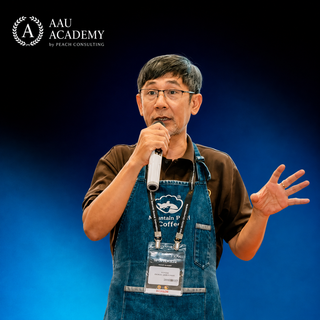
Hoang Van Thanh
Founder of Mountain Pearl Roastery Coffee, leading the technical block
Leads the four technical sessions at the roastery: green beans and supply chain, roasting and roast profile standardization, extraction for replication, tasting and blending.
Tuition and what's included
A Deployable Business Model File
Eight components built up after each session and finalized at the wrap-up session, detailed enough to work with the design team, green bean suppliers and the operations team.
Program Completion Certificate
Learners who complete the program and present their model file receive the course certificate.
Recommended class size is 12 to 16 learners per course. Includes a set of templates for building the business model file, hands-on practice on equipment at the roastery, and a certificate of completion issued by AAU Academy × Mountain Pearl Roastery after learners present their file at the wrap-up session.
Frequently asked questions
Answers to common questions before you register.
I have no coffee knowledge. Can I still take the course?
Yes. The technical block starts from the basics of green beans and roasting principles, at a level sufficient for investors and business owners to lead, control quality and make decisions. No prior brewing experience is required.
Does the course teach brewing to work as a barista?
No. This is an investment and business model operations program. The brewing practice helps you understand the four extraction variables and standardize recipes for your own bar. It does not replace barista vocational training.
Where is the course held and how do I get there?
Sessions 1 to 4 are at AAU Academy, 343 Pham Ngu Lao, District 1. Sessions 5 to 8 are at Mountain Pearl Roastery, Quang Trung Street, Thu Duc City. The detailed schedule is sent before the course starts.
What should I prepare before joining?
Your investment budget direction, the premises area you are targeting, and any existing figures if you already run a cafe. All templates for building the model file are provided by the program.
I already have a cafe. Is the course suitable?
Yes. Much of the content is aimed at upgrading a running model: standardizing input quality, redesigning the menu and pricing, standardizing extraction recipes, and the conditions for replication or setting up a central roastery.
What is the class size?
We recommend 12 to 16 learners per course so everyone can practice directly on equipment at the roastery and have their file critiqued at the wrap-up session.
When is the next intake?
The course starts on Friday 25 Sep 2026, with afternoon classes on Friday, Saturday and Sunday from 14:00 to 17:00, ending on 10 Oct 2026. The first four sessions are at AAU Academy, 343 Pham Ngu Lao; the last four are at Mountain Pearl Roastery, Thu Duc City. Call 0565 66 76 86 to reserve a seat.

Build your specialty coffee model with AAU × Mountain Pearl
Leave your details and the AAU team will contact you for a free consultation within 24 hours and confirm the nearest intake schedule.
Or call now 0565 66 76 86 (Mon–Sat, 9h–18h)